
Schmidt Projection
The basis for all projection techniques is the imaginary reference sphere of radius R, positioned with its centre at the centre of the area of projection. Consider a line oriented with the trend a and plunge b, and positioned so that it passes through the centre of a reference sphere. If this line is extended, it pierces the perimeter of the reference sphere at two points: P on the lower hemisphere and Q on the upper hemisphere.
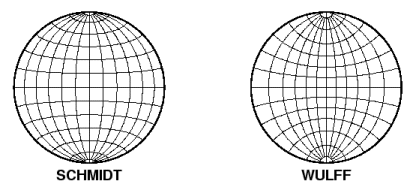
A point on the lower hemisphere, such as P, can be projected onto the horizontal plane using different projection methods. Stereonet supports equal-angle and equal-area projections. The Schmidt projection is the equal-area method.
The Wulff Projection is the equal-angle method.
A Schmidt projection is a Lambert azimuthal equal-area projection of the lower hemisphere of a sphere onto the plane of a meridian.
For the equal-area projection, the given line of trend a and downward plunge b intersects the lower reference sphere at point P'. This point is projected by swinging it in a vertical plane through a circular arc centred at B, located at distance R vertically below O, to point P''. P'' is projected to P, where the arc intersects the lower reference hemisphere, and then in a straight-line extension of the chord P'' - P' on the plane of projection, which is the horizontal plane.
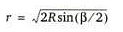
For this projection, the relationship between r, the radial distance of point P from O, and b is given by:
The following diagram compares Wulff equal-angle and Schmidt equal-area projections:
Reference: Rock Slope Stability by Charles A. Kliche, published by SME, 1999.
Related topics and activities:
